
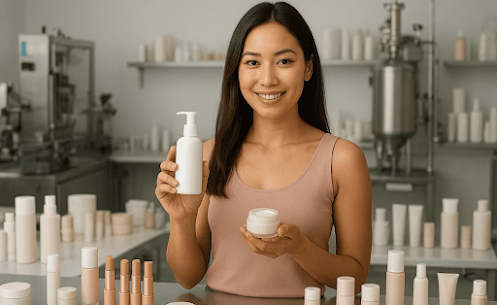
Launching a beauty brand is only the first step — the real challenge often lies in scaling cosmetics production. For many startup beauty brands, moving from small volume to large runs can be daunting. But with the right strategy, you can grow smartly, sustainably, and profitably. In this post, we’ll walk through what scaling production means, common hurdles, and how to partner with a contract manufacturer to support your growth.
Why Scaling Cosmetics Production Matters
- Demand Growth
The global cosmetics contract manufacturing market was valued at USD 23.7 billion in 2024 and is expected to grow at a CAGR of 4.4%, thanks to rising outsourcing and brand innovation. - Cost Efficiency
As you increase production, your per-unit cost tends to go down. Higher volumes allow you to absorb fixed costs like formulation, quality-control, and packaging more effectively. - Brand Expansion
When you can scale up, you can introduce more SKUs (skins, colors), expand into new markets, and respond faster to trends. - Investor Confidence
A brand that has demonstrated scalable operations is more attractive to investors — they can see the pathway to profitability.
Key Challenges When Ramping Up Production
Scaling isn’t just “make more products.” Here are some common snags:
- High Minimum Order Quantities (MOQs):
Many manufacturers set MOQs to recover setup costs, often thousands of units. - Quality & Compliance:
Larger production means stricter quality control, stability testing, and regulatory compliance. - Cash Flow Pressure:
Bigger production runs tie up working capital — for raw materials, packaging, labor. - Supply Chain Constraints:
Ingredients, especially actives or niche raw materials, may have their own MOQs, creating bottlenecks. - Manufacturing Flexibility:
Moving from a small, agile setup to a rigid, high-capacity line can slow you down if not managed carefully.
Practical Steps to Scale Successfully
Here’s a structured roadmap to scale your beauty business’s production.
1. Start with Low-Volume Batches
Begin with small batch production. Many modern contract manufacturers support lower MOQs today — as low as 500–1,000 units — enabling market testing without a huge upfront investmen.
This model (sometimes called “small-batch” or “small-batch specialist”) helps you validate your hero SKUs before you commit to larger runs.
2. Choose a Growth-Friendly Manufacturer
Look for partners who are set up to support your brand over time — not just for the first order. Key traits to evaluate:
- Flexible production systems
- Ability to scale from small volumes to large runs
- Transparent cost structure
- Experience in your product category (skincare, color, haircare, etc.)
- Certifications (GMP, ISO, safety testing)
If you’re a startup, consider private label cosmetics manufacturer partners — they often have ready-made formulas, established lines, and experience scaling.
3. Negotiate MOQs Wisely
Work with your manufacturer to:
- Use standard base formulas or modular formulations (rather than fully custom) early on
- Use stock packaging instead of fully customized packaging
- Phase orders — place smaller first orders, then ramp up in steps
This way, your MOQs cosmetics are more manageable, and you’re not stuck with inventory you can’t sell.
4. Build a Scaling Infrastructure
Set up your business so that scaling doesn’t break you:
- Maintain a financial buffer for inventory, QC, and regulatory costs
- Implement robust quality assurance from early on
- Use packaging that works for both small and large runs
- Leverage contract manufacturers’ R&D or formulation support
5. Monitor & Optimize
As you scale:
- Track production lead times, yield, defects, and costs
- Run regular stability and safety tests
- Use sales data to forecast demand and plan your next scale-up
- Reassess your growth-friendly manufacturing partner regularly
Why Beauty Startups Need Growth-Friendly Manufacturing
For a startup, working with a manufacturing partner who understands scaling is not just beneficial — it’s strategic. “Growth-friendly manufacturing” means having a partner who can support you as you move:
- From initial test runs
- To a few thousand units
- To full-scale production
When your manufacturer can handle ramping production beauty (i.e., increasing scale without compromising on quality or speed), you reduce risk, avoid quality hiccups, and stay agile.
The Role of Outsourced / Contract Manufacturing
Outsourcing is often the backbone of scaling for beauty brands. The cosmetics outsourced manufacturing services market is expected to reach USD 45.37 billion by 2033, growing at a CAGR of 4.4%.
This massive growth speaks to why more brands prefer to partner rather than build their own factories — they want:
- Speed to market
- Cost-efficient scale
- Access to expert formulation
- Regulatory and quality infrastructure
Financial Perspective: Cost of Scaling
Let’s break down some key financial considerations:
| Cost Area | Early (Small Run) | When Scaling to Large Runs |
| Raw Materials | Higher per-unit cost | Lower per-unit due to bulk purchasing |
| Quality Control / Testing | Essential, but volume is low | More frequent batches → more QC cost; but cost per unit decreases |
| Packaging | Use stock bottles / jars; low customization | Greater bargaining power, cheaper molds per unit |
| Production Setup | Setup costs spread over fewer units | Fixed cost diluted over large run |
| Cash Flow | Lower capital tied up | More working capital needed, but more leverage for negotiation |
Risk Mitigation When Scaling Cosmetics Production
- Do test orders: Before jumping into a large run, try a mid-sized batch to validate your process, packaging, and demand.
- Negotiate rollback clauses: If demand doesn’t pick, have a clause to reduce your next order.
- Build buffer stock smartly: Keep some inventory, but avoid overstocking.
- Maintain strong quality checks: Larger runs amplify any mistake. Use batch records, audits, and stability testing.
- Stay flexible: If your partner can’t scale, have backup manufacturers or a plan to shift production.
Real-World Example
Imagine a DTC (direct-to-consumer) beauty startup that begins by producing a serum in a batch of 800 units through a private label cosmetics manufacturer. The first lot sells out within months, based on social media demand.
The brand then negotiates with its manufacturer to scale up to 5,000 units. Because the formulation is based on a stock base (not fully custom), and because they agreed to use standard packaging, the per-unit cost drops substantially. The brand reinvests the savings into a new shade for its toner, while also allocating some margin to fund sustainable cosmetic packaging for future runs.
Scaling and Sustainability: A Balanced Approach
As your production grows, it’s also smart to think about sustainability. Working with a color cosmetics manufacturer (or a contract partner) who offers eco-conscious options (recyclable jars, refill systems, or post-consumer recycled materials) can help you scale responsibly. This not only reduces environmental impact but also resonates with modern consumers who care about “green beauty.”
If sustainability is central to your brand, consider incorporating ideas around clean beauty manufacturing and eco-friendly cosmetic manufacturing into your scaling strategy. For example:
- Use refillable packaging
- Source recyclable or biodegradable materials
- Choose a manufacturer committed to clean production practices
These decisions may slightly raise costs initially, but they help you build a growth-friendly manufacturing model aligned with brand values and consumer demand.
Conclusion
Scaling cosmetics production isn’t a simple “make more stuff” game. It involves careful planning, smart partnerships, and a deep understanding of how manufacturing works — especially when transitioning from small volume to large runs.
By choosing the right manufacturing partner, negotiating sensible MOQs, investing in quality systems, and maintaining flexibility, you can grow your brand steadily and sustainably. For startups, leveraging contract manufacturing (OEM or private label) gives you access to expertise, economies of scale, and speed — without the huge capital burden of building your own plant.If you’re ready to scale, take a moment to evaluate your current production approach. Are you working with someone who can support long-term growth — someone who understands ramping production beauty? If not, it might be time to rethink how you manufacture.