
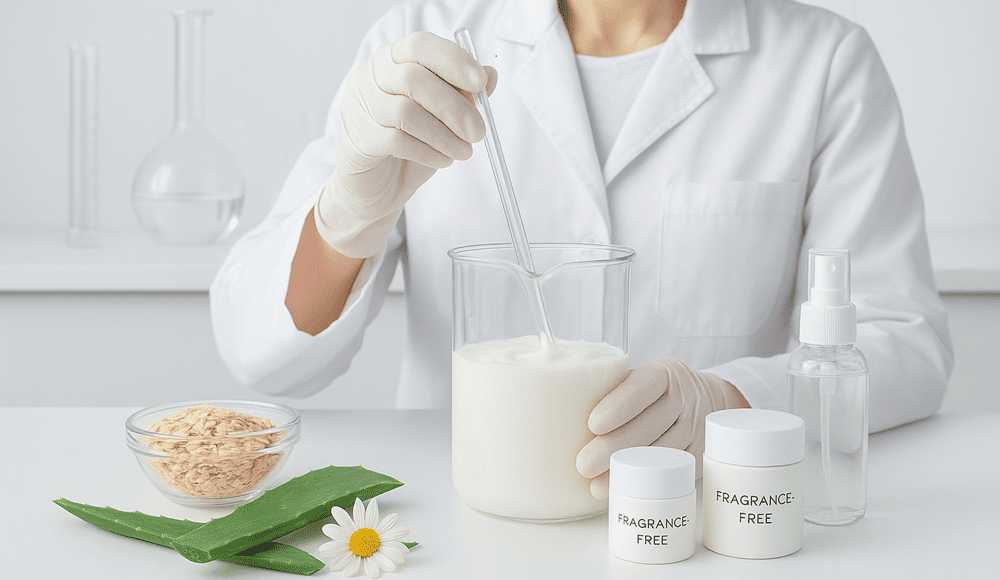
In today’s beauty market, manufacturing products that are genuinely safe for sensitive skin isn’t just a nice‐to‐have, it’s becoming a core business imperative. When you build your production around fragrance free skincare production, you’re positioning your brand (or your contract manufacturing clients) for longer-term relevance.
Here’s why:
- Many consumers now report sensitivity to additives and scents. According to an industry analysis, around 30% of the U.S. population may have some degree of sensitivity to fragrance in personal care products.
- The overall “clean beauty” market (which overlaps strongly with fragrance-free offerings) is expanding rapidly — the global clean beauty market was estimated at USD 8.25 billion in 2023 and projected to reach USD 21.29 billion by 2030.
- Brands that emphasize hypoallergenic skincare and dermatology tested claims are gaining trust among consumers with skin concerns such as eczema, rosacea or simply general sensitivity.
So if you run, or are planning to run, a cosmetics manufacturing business (or supply to one) focusing on fragrance-free production can give you a competitive edge.
Understanding Fragrance-Free Skincare Production
When we say fragrance free skincare production, what we’re talking about is more than just leaving out perfume ingredients. It involves an end-to-end approach: skincare formulation, sourcing, manufacturing, packaging and claims, all tailored to avoid fragrance (and often other potential irritants) and meet the needs of sensitive skin cosmetics.
Key pillars to consider:
- Ingredient selection: Avoiding added fragrance (synthetic or natural aroma blends) is the core. But you also review all excipients, botanical extracts, essential oils (if used) and their potential for sensitisation.
- Formulation path: The product must be developed with the minimal-necessary ingredients, ideally with a robust allergen-free formulation path (avoiding common triggers). Ensuring low irritation potential and compatibility with sensitive skin is essential.
- Testing & claims: Incorporating dermatology tested protocols and hypoallergenic claims builds trust. Ideally you also test on target skin types (sensitive, reactive) or in labs that specialise in that.
- Manufacturing environment: Your production lines must ensure that fragrance cross-contamination is avoided (if your facility also makes fragranced products). Clean builds, dedicated equipment or strict cleaning regimes matter.
- Labelling & communication: Clearly stating “fragrance-free”, maybe “unscented” (if correct), and supporting with claims such as “for sensitive skin”, “hypoallergenic” helps target the right audience and avoid confusion.
- Clean beauty alignment: Many consumers who go fragrance-free also expect broader standards: minimal additives, transparent sourcing, less controversial ingredients. The “clean beauty lab” mindset plays into this.
Why it’s Good Business for Manufacturers
From a manufacturing or private-label branding perspective, prioritising fragrance free skincare production offers multiple advantages:
- Wider target audience. Lots of customers avoid fragrance for skin reasons. By offering products labeled for sensitive skin cosmetics, you open up a larger market.
- Differentiation. Many brands still use scents as a differentiator. By doing fragrance-free, you can specialise and stand out in the “gentle/derm-safe” niche.
- Compliance & future-proofing. As regulatory scrutiny on fragrance allergens and sensitive-skin claims increases, being ahead means fewer surprises.
- Premium positioning & margin. Often, fragrance-free products can command higher price points because they serve a premium need (sensitivity, allergen-free, dermatologist-tested).
- Scalability. Once you build a clean line with fragrance-free production, you can expand adjacent SKUs (moisturizers, cleansers, serums) more easily — and sell into the growing segment. For example, one report estimated the fragrance-free skincare market size at USD 4.5 billion in 2024 and projecting to USD 8.1 billion by 2033 (CAGR ~7.2%). Verified Market Reports
Production Workflow: From Concept to Launch
Here’s a step-by-step overview of how you might run fragrance-free skincare production in your manufacturing facility.
- Market brief & product specification
- Define the target consumer: e.g., adults with sensitive skin, allergy-prone, minimal fragrance preference.
- Decide product category: e.g., moisturizer, serum, cleanser.
- Set claims: “Fragrance-free”, “Allergen-free formulation”, “Dermatology tested”.
- Map competitive landscape and cost target.
- Define the target consumer: e.g., adults with sensitive skin, allergy-prone, minimal fragrance preference.
- Formulation design
- Choose base ingredients with low irritation potential.
- Avoid fragrance compounds and high-risk botanicals/extracts known to trigger reactions.
- Work with a clean beauty lab to ensure ingredient transparency and minimal additives.
- Choose base ingredients with low irritation potential.
- Pilot batch & testing
- Manufacture small pilot run; check for stability, sensorial feel (since fragrance is omitted, you must ensure texture/scent/feel are still pleasant).
- Run dermatological tests on sensitive skin volunteers or appropriate panel.
- Confirm hypoallergenic status with patch tests where possible.
- Manufacture small pilot run; check for stability, sensorial feel (since fragrance is omitted, you must ensure texture/scent/feel are still pleasant).
- Scale manufacturing
- Ensure production lines are free from fragrance residues (if your factory also makes scented products).
- Use dedicated or carefully cleaned equipment.
- Consider batch segregation and traceability of all inputs (to support allergen-free claims).
- Ensure production lines are free from fragrance residues (if your factory also makes scented products).
- Quality control & release
- Implement QC checks: appearance, pH, microbial, skin-safety tests.
- Review ingredient label (INCI) with legal/regulatory team to ensure “fragrance-free” claim is valid.
- Implement QC checks: appearance, pH, microbial, skin-safety tests.
- Packaging & labelling
- Choose packaging that protects the sensitive formulation (UV protection, airtight).
- Clearly label “Fragrance-free”, mention suitable for “sensitive skin”, maybe “dermatologist tested”.
- If your facility offers private-label services, you can incorporate custom branding.
- Choose packaging that protects the sensitive formulation (UV protection, airtight).
- Launch & consumer communication
- Emphasise why fragrance-free matters (for skin health, allergies, minimalism).
- Provide consumer education on what “fragrance free” means and why it matters for sensitive skin.
- Support the claim with dermatologist quotes or clinical proof where possible.
- Emphasise why fragrance-free matters (for skin health, allergies, minimalism).
Product Portfolio Ideas & Market Opportunity
When you focus on fragrance-free skincare production, you can build a full line tailored for sensitive skin and allergen-free demand. Here are some ideas and notes:
| Product Type | Considerations for Fragrance-Free |
| Gentle Cleanser | Mild surfactants, free from essential oils/scent. Ideal start point for sensitive skin line. |
| Hydrating Moisturizer | Focus on barrier-repair actives (ceramides, niacinamide) and no scent. |
| Soothing Serum | For redness/irritation, fragrance-free and dermatology tested. |
| Face Oil or Night Cream | Very careful with botanicals; oils often have natural scent which may conflict with “fragrance-free” claims—need to register that appropriately. |
| Body Care (lotions, creams) | Often overlooked, but body products for sensitive skin are also in demand. Trend data shows expansion of fragrance-free body care. |
As noted earlier, the fragrance-free skincare market is projected to grow steadily (CAGR around 7% according to one report).
If you align this product line with clean beauty lab standards, the angle becomes even stronger.
Challenges & How to Mitigate Them
No production path is without its hurdles. Here are key challenges specific to fragrance-free skincare production and how to address them.
1. No scent” may feel less luxurious
Many consumers associate scent with the “spa” or “premium” feel. Without fragrance, lesser perceived sensory appeal is possible.
Mitigation: Focus on texture, packaging, branding, and messaging. Use subtle touches (like gentle natural extracts with neutral scent) while staying true to fragrance-free. Educate consumers that “unscented” doesn’t mean “boring”.
2. Cross-contamination in multi-product facilities
If your manufacturing site also makes fragranced products, there is a risk of trace scents or residues.
Mitigation: Use dedicated lines if possible, or rigorous cleaning protocols, segregated production batches, and audit trails.
3. Defining “fragrance-free” and claims compliance
Regulations differ by market. Avoid ambiguous terms like “scent-free” vs “fragrance-free”.
Mitigation: Consult regulatory experts, ensure your formulation truly meets fragrance-free definitions in the target market, retain documentation for the “dermatology tested” and “hypoallergenic” claims.
4. Ingredient cost and formula optimisation
Gentler ingredients may cost more (specialty surfactants, dermatologically-safe excipients).
Mitigation: Plan your cost base early, streamline SKU count, and build scale. Some fragrance-free lines can justify premium pricing due to niche positioning.
How to Position Your Brand / Manufacturing Offering
If you’re a manufacturer or brand owner looking to offer or market fragrance-free skincare production, here are some positioning tips:
- Emphasise your expertise in hypoallergenic skincare and targeted production for sensitive skin cosmetics.
- Highlight your facility’s capability: “fragrance-free lines”, “allergen-free formulation”, “dermatology tested prototypes”.
- Use case studies or testimonials from brands you manufacture for (respecting confidentiality) to show success in fragrance-free launches.
- Offer “clean beauty lab” services: custom development, safe ingredient sourcing, packaging optimisation for sensitive consumers.
- Provide education material for your brand-clients: on why fragrance-free matters, how to market it, what consumer segments care about.
- Offer scalable options: from small runs (for start-ups) to full scale (for established brands expanding into fragrance-free lines). This ties into the concept of starting a skincare brand with minimal risk and proof.
The Future Outlook: What’s Next in Fragrance-Free Production
Looking ahead, some skincare trends to keep in mind:
- Customised formulations using AI or skin analytics will increasingly ask for fragrance-free and ingredient-minimal options.
- The “clean beauty” umbrella will continue to expand, and fragrance-free will become more of a baseline expectation than a niche claim.
- Diversification into body care, baby care, and men’s grooming for fragrance-free will grow.
- Brands may merge fragrance-free with other premium claims (microbiome-friendly, barrier repair, dermatology-approved) to build stronger value propositions.
- For manufacturers, build-out of dedicated fragrance-free lines and earlier integration of allergen-free formulation will be an operational differentiator.
Final Thoughts
If you’re in the business of producing skincare or supporting brands, embracing fragrance free skincare production is a strategic move. It aligns with consumer demand for safer, gentler, more transparent products, particularly in the sensitive-skin segment.
By combining that with hypoallergenic skincare, allergen-free formulation, and dermatology tested credentials, you create an offering that commands attention—and trust.In this evolving landscape, manufacturers who incorporate clean, specialised lines (sometimes under the umbrella of a clean beauty lab) and work with brands looking to launch or expand can carve out a solid niche.
If you also support clients who are starting a skincare brand, or who already produce colored cosmetics and now want to expand into skincare, you’re well-positioned for growth.