
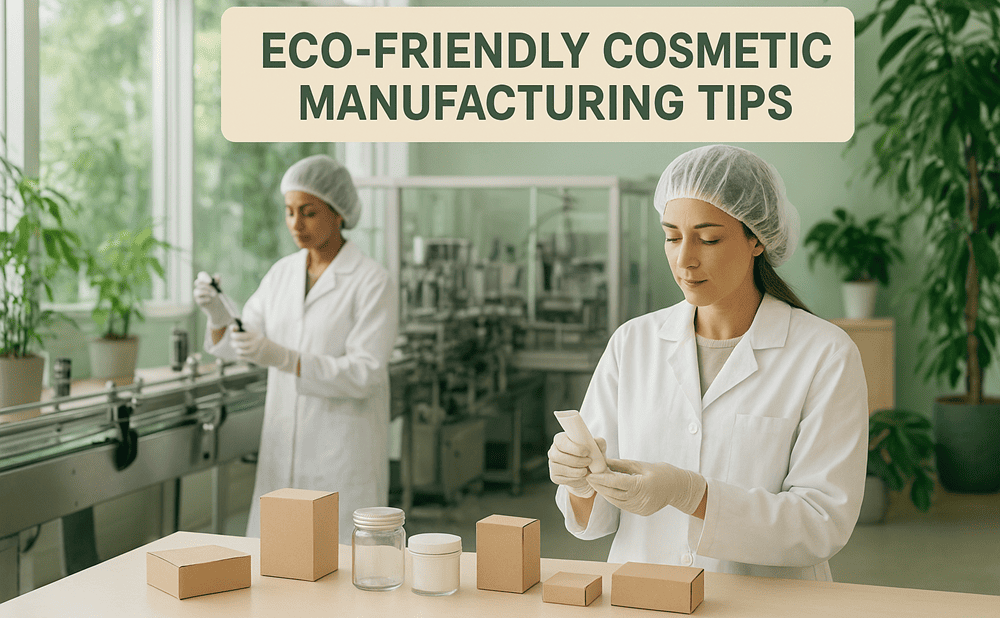
In today’s beauty industry, clients expect more than just performance. They care about the planet. For manufacturers, adopting eco-friendly cosmetic manufacturing isn’t a luxury—it’s becoming an imperative. Green practices help reduce environmental impact, build brand trust, and often lead to cost savings in the long run.
This guide shares concrete tips for beauty business owners to make their production more sustainable and attractive.
Why Sustainable Practices Matter
- The global sustainable beauty and skincare market was valued at USD 190.7 billion in 2024 and is projected to reach USD 433.2 billion by 2034, growing at an ~8.6% CAGR.
- In the U.S., 54% of consumers reported deliberately buying products with sustainable packaging in the past six months.
- Nearly 95% of cosmetic packaging ends up discarded, and only about 9-14% is effectively recycled.
These numbers show opportunity: manufacturers who do sustainable beauty production, green packaging for cosmetics, and low-waste beauty factory operations can win both ethically and commercially.
Key Elements of Eco-Friendly Cosmetic Manufacturing
Here are the crucial areas to address:
| Element | What It Means | Why It Helps |
| Ingredient sourcing | Using raw materials that are cruelty-free, ethically sourced, and preferably renewable/biobased. | Reduces harm to ecosystems & animals; builds consumer trust. |
| Formulation efficiency | Reducing water content, avoiding unnecessary fillers, simplifying formulas. | Less resource use in production; smaller carbon footprint. |
| Packaging design & materials | Using recyclable, compostable, reusable, or minimal packaging; avoiding excessive wrapping. | Cuts down waste; responds to consumer demand. |
| Energy & water use in factory | Using renewable energy, recycling wastewater, optimizing heating/cooling. | Less pollution & lower operating costs. |
| Waste management | Reusing off-cuts, recycling scraps, choosing low waste / zero-waste processes. | Minimizes landfill; shows sustainable operation. |
Practical Tips to Implement
Here are actionable steps manufacturers can take:
1. Audit your supply chain
Check where your raw materials come from. Make sure ingredients are cruelty-free, traceable, and ideally certified (organic, fair trade, etc.). This supports cruelty-free ingredient sourcing and helps you spot inefficient stages where waste or emissions are high.
2. Simplify formulations
Use fewer but higher-quality ingredients. Formulas that avoid over-processing use less energy. Also explore waterless or low-water formulas (powders, solids) which reduce transport weight and decrease spoilage risks.
3. Choose packaging wisely
- Go for recyclables: glass, aluminium, bioplastics, paper/cardboard.
- Use minimal packaging: reduce layers, use smaller sizes.
- Consider refillable or reusable containers.
This directly supports green packaging for cosmetics and helps reduce discarded packaging.
4. Energy & waste reduction in facilities
- Install solar panels or use partial renewable energy.
- Recycle or reuse water (for cleaning, cooling).
- Use efficient machinery, LED lighting, etc.
5. Partner with ethical ingredient and material suppliers
Seek suppliers who are transparent, use sustainable agriculture, avoid animal testing. This supports sustainable skincare manufacturing and cruelty-free ingredient sourcing.
6. Implement quality control to minimize rejects
Defective batches or mis-runs are waste. Better QC upstream means fewer discarded materials and less reprocessing.
7. Use lean manufacturing / low-waste beauty factory practices
Lean planning, smaller batch sizes, just-in-time inventory help avoid overproduction and excessive storage, which in turn lowers waste and storage emissions.
Integration Into Business Models
Eco-friendly cosmetic manufacturing isn’t just about tweaking production—it can reshape your business model.
- Private label cosmetics manufacturing brands can offer “green lines” or “eco ranges” to clients who want to sell sustainable products without making their own factory.
- Develop custom makeup formulations that use sustainable pigments, natural oils, and minimal synthetic additives; these appeal strongly to eco-conscious brands.
- If your clients include skincare or hair care brands, align with skin care manufacturer or hair care product manufacturer standards for safe, sustainable processing and clear labeling.
Common Challenges & How to Overcome Them
| Challenge | Possible Solution |
| Higher upfront cost of sustainable materials | Bulk purchasing, long-term supplier contracts; communicating value to customers so you can charge premium if justified. |
| Finding trustworthy suppliers | Use certifications, audits; start small; build relationships. |
| Regulatory & compliance issues | Keep current on laws in regions you ship to; sometimes green claims are regulated (watch for greenwashing). |
| Consumer doubt or skepticism | Transparent labeling, share case studies, publish your sustainability metrics. |
Examples & Case Studies
- A brand switched to post-consumer recycled plastic (PCR) for its bottles and reduced new plastic use by ~40%. They promoted green packaging for cosmetics as a key differentiator and saw an uplift in repeat customers.
- A low-waste beauty factory reduced water consumption by implementing closed-loop water systems; saved thousands of liters per month and cut energy costs.
- Some companies in the sustainable beauty production space are adopting refill packaging; refillable makeup sales grew by 364% in early parts of 2022. Meyers
How to Measure Progress
To ensure your manufacturing becomes more eco-friendly over time, set metrics and track them. Some useful ones:
- Percentage of ingredients that are cruelty-free / ethically sourced
- Volume of packaging diverted from landfill (recyclable / compostable / reusable)
- Energy usage per unit produced
- Water usage per liter (or kg) of product
- Rate of production defects / waste per batch
Regularly review and set targets (e.g. reduce waste by 20% in 12 months).
Conclusion
Transitioning toward eco-friendly cosmetic manufacturing is both an ethical journey and a strategic advantage. By focusing on sustainable beauty production, using green packaging for cosmetics, sourcing ingredients with integrity, and setting up your facility to be a low-waste beauty factory, you’ll not only reduce environmental impact but also cater to increasingly conscious consumers.
If your beauty business is considering how to start or improve, think holistically—from core formulation, packaging, through to energy and waste. And remember, internal improvements often translate into stronger external brand reputation.